General Dermatology in Upland, CA
Acne Treatment
Although acne is most commonly a condition that occurs in the teenage years, almost every day we see an adult who laments that they still get acne breakouts. Acne can cause much frustration and self-consciousness, and if acne is extensive, may lead to scarring which is difficult or even impossible to improve.
At Skin Physicians and Surgeons our dermatologists treat both adolescents and adults suffering with acne. We’ll create a custom acne treatment program specifically designed to improve your skin. This may include prescription oral and topical medications, chemical peels or recommendations for a cosmeceutical specifically created to improve acne.
Call 909-981-8929 to schedule your acne treatment consultation.
Mole Removal
The average person has approx. 100 moles on their body! Moles that are suspicious, irritated, or cosmetically unappealing can be safely and easily removed. Mole removal is a very safe and common procedure performed in our medical office.
The mole removal process is simple. Generally, the area around the mole is numbed with a local anesthetic and the mole is removed flush with the skin, or by excision which may require a few sutures. The mole removal procedure is quick and painless. Once the mole is removed it’s examined under a microscope to ensure it’s not cancerous.
To be safe, you should have a full body skin exam every 2-3 years but if you have a family or personal history of skin cancer, in particular melanoma, we recommend a skin exam at least every year to check for suspicious moles. You can request a male or female physician so you feel most comfortable.
Call 909-981-8929 to schedule your mole removal consultation.
Skin Cancer Treatment
Early detection of skin cancer and skin cancer prevention is the key to maintaining healthy skin. At Skin Physicians & Surgeons complete skin exams are conducted by board certified dermatologists and highly qualified physician assistants, trained in the diagnosis and treatment of skin cancer. Periodic self examination is highly recommended.
There are 3 common types of skin cancers
Basal Cell Carcinoma: This is the most common type of skin cancer. Basal cell carcinoma is the most common type of cancer overall as well. Basal cell carcinomas typically appear as flesh colored, pink, or red bumps that persist, and may bleed, heal up, then bleed again. They are directly related to sun exposure and therefore occur most commonly on sun-exposed areas such as the face, neck, and upper body.
Basal Cell Carcinoma occurs most commonly on people with light-colored hair and eyes, particularly if they don’t tan easily. The good news about basal cell carcinomas is that they’re very slow growing and are almost always confined to the skin. In other words, they have a very low risk of spreading internally (metastasizing). Basal cell carcinoma can be treated and cured effectively by a dermatologist and/or Mohs Micrographic Surgery.
Squamous Cell Carcinoma: This type of skin cancer is the second most common. Like basal cell carcinomas, they’re most commonly seen in fair-skinned people, particularly in sun-exposed areas. They appear most commonly as red or pink bumps or scaly rough areas. They are commonly found on the tips of the ears, the face, and the lips, but they can occur anywhere on the body.
This type of skin cancer is slow growing, but if allowed to develop to a very large size, has the potential to spread internally (metastasize) and potentially affect other parts of your body. However, for the most part, this type of skin cancer can be treated and cured by a dermatologist and/or Mohs Micrographic Surgery.
Malignant Melanoma: Melanoma is the deadliest form of skin cancer. At the time of its diagnosis, there is a much higher chance that it has spread to other areas of the body. In the past two decades, melanoma incidence has tripled. It is a cancer that affects young people. 1 in 4 persons who develops a melanoma is under 40 years old. While it is the 9th most common human cancer, it is second only to adult leukemia in terms of loss of potential years of life. However, if diagnosed early and removed while it is still very superficial in the skin, it can be almost 100% curable.
Melanomas originate in melanocytes, the cells which produce the pigment melanin that darkens our skin, hair and eyes. This pigment and cell type are most concentrated in our moles. The majority of melanomas are black or brown, but they can stop producing pigment and may appear skin-colored, pink, red, or purple.
Melanomas can appear on normal skin or within an existing mole. It is important to be aware of the location and appearance of the moles on your body. You should monitor your body for any changes in existing moles or the appearance of a new mole. Suspicious signs of melanoma can be summarized by the ABCDE’s:
Asymmetrical Melanomas
Most melanomas are asymmetrical: A line through the middle would not create matching halves. Common benign moles are round and symmetrical. (See examples below)
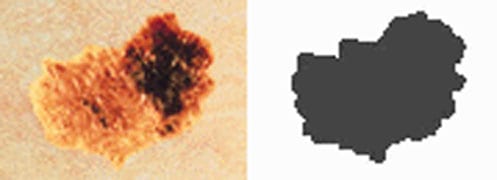
Most melanomas are asymmetrical: A line through the middle would not create matching halves. Common benign moles are round and symmetrical. (See examples below)
Melanomas with Border Irregularity
The borders of early melanomas are often irregular with scalloped or notched borders. Common benign moles have smoother, more even borders. (See examples below)
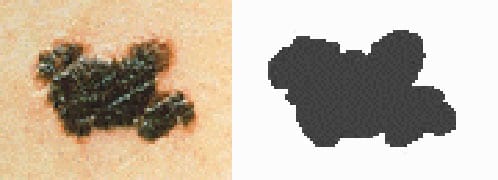
The borders of early melanomas are often irregular with scalloped or notched borders. Common benign moles have smoother, more even borders. (See examples below)
Melanomas with Color Variability
Varied shades of brown, tan or black are often the first signs of melanoma. As melanomas progress, colors of red, white or blue may appear. Common benign moles are usually a single shade of brown. (See examples below)
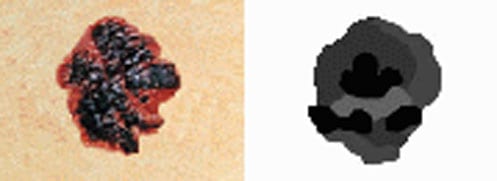
Varied shades of brown, tan or black are often the first signs of melanoma. As melanomas progress, colors of red, white or blue may appear. Common benign moles are usually a single shade of brown. (See examples below)
Melanoma Diameter
Melanomas tend to grow a greater size than a common mole, generally at least the size of a pencil eraser (6mm diameter).
Melanoma Evolution
Moles should be watched over time, and if they show evidence of growing or changing, this increases the chances that they may be developing into a melanoma.
Remember, these are only guidelines to help you monitor your moles at home, an important aspect to maintaining healthy skin. Moles that do not have any of these suspicious signs could still be a melanoma, and we recommend having an examination by a board certified dermatologist to make a definitive diagnosis.
Please contact us at Skin Physicians & Surgeons for a complete skin exam or to examine something of concern.
Call 909-981-8929 to schedule your cancer treatment consultation.
Scar Removal
A scar’s appearance will depend on its color, texture, depth, length, width or location. How the scar forms will also be affected by an individual’s age and location on the body or face. Younger skin makes strong repairs and tends to overheal, resulting in larger, thicker scars than on older skin. Skin over a jawbone is tighter than skin on the cheek and will make a scar easier to see. If a scar is depressed, it will make skin seem shaded, and if it is higher than surrounding skin, it will cast a shadow. A scar that crosses natural expression lines will be more apparent because it will not follow a natural pattern, and a scar that is wider than a wrinkle will stand out because it is not a naturally occurring line. Any one, or a combination, of these factors may result in a scar that, although healthy, may be improved by treatment.
Any one, or a combination, of these factors may result in a scar that, although healthy, may be improved by treatment.
What Can and Cannot Be Done for Scars?
Several techniques can minimize a scar. Most of these are done routinely in the dermatologist’s office with local anesthesia. Only severe scars, such as burns over a large part if the body, require general anesthesia and hospital stay.
Surgical scar revision can change the length, width, or direction of a scar; raise depressed scars, or lower elevated scars. However, no scar can be completely erased; and no magic technique will return skin to its uninjured appearance. Surgical scar revision can provide improvement in the appearance of the skin, while leaving another-though less obvious-mark. In addition, a scar’s color cannot be altered; as it gets older, it usually fades and can often be hidden with make-up, but a certain difference in pigmentation will usually remain.
The most important step in the treatment of scars is careful consultation between patient and dermatologist-finding out what bothers a patient most about a scar and deciding the best treatment. Physicians stress that each scar is different, and each requires a different approach.
Scar Treatment
Surgical Scar Revision. The surgical removal of scars is a best suited to wide or long scars, those in prominent places, or scars that have heal in a particular pattern or shape. Based on the ability of the skin to stretch with time, surgical scar revision is a method of removing a scar and rejoining the normal skin in a less conspicuous fashion. Wide scars can often be cut away and closed, resulting in a narrower, less obvious scar, and long scars can be shortened.
Dermatological surgeons may use a technique of irregular or staggered incisions lines, rather than straight-line incisions, to form a broken-line scar which is much more difficult to recognize. Sometimes, a scar’s direction can be changed so that all or part of the scar that crosses a natural wrinkle or line falls into the wrinkle, making it less noticeable. This method can also be used to move scars into more favorable locations, such as into a hairline or a natural junction (for instance, where the nose meets the cheek.)
Best results are obtained when the scar is removed and wound edges are brought together without tension. Accordingly, scar removal is planned with great care for the details of the muscle layers.
Laser Resurfacing
Laser resurfacing, is a method of treating fine scars or minor irregularities of surface skin, and improving the look of some surgical scars or acne scars. Laser resurfacing levels out irregularities in the contour of the skin and may offer improvement for certain scars, although it cannot get rid of the scars. Laser resurfacing has been used with favorable results on acne scars, chickenpox scars, tattoos, wrinkle lines, and surgical scars. Patients can usually return to work within two weeks; some patients can return to work after only one week. If defects are minor, only one treatment will be needed. Several treatments, may be required if defects are deep and extensive, as in deep acne scars. A high energy light is used to burn away unwanted, damaged skin.
Fillers are substances used to raise sunken soft, scars. The amount injected will vary with the size and firmness of the scar.
Punch Grafts
Punch grafts are small pieces of normal skin used to replace scarred skin. A tiny instrument is used to punch a hole in the skin and remove the scar. The area is then filled in with a matching piece of unscarred skin, usually taken from the back of the earlobe. The “plugs” are taped into place for five to seven days as they heal. Even though the punch grafts form scars of their own, they provide a smooth skin surface which is far less visible than depressed scars. This is the best treatment for deep acne scars.
Chemical Peels
Chemical peels remove the top layer of the skin with a chemical in order to smooth depressed scars and give the skin a more even color. This technique is helpful for superficial scars, and is often used to treat sun-damaged or irregularly colored skin. The chemical peel is applied to the skin with an ordinary cotton-tipped applicator beginning on the forehead and moving over the cheeks to the chin. Different chemicals can be used for different depth peels. Light peels require no healing time while deeper peels can require up to two weeks to heal. The amount of scarring and color change determines the type of peel selected.
Cortisone Injections
Cortisone Injections are effective in softening very firm scars (or keloids) causing them to shrink and flatten.
Cosmetics
Cosmetics applied correctly can be very good at covering up scars. Physicians encourage patients to wear make-up after scar treatments. Make-up will improve the appearance while nature completes the healing process.
Call 909-981-8929 to schedule your scar removal consultation.


 Watch Video